DemoFlick makes the hard decisions in Boords, before animation makes them costly
DemoFlick makes animated explainer videos, SaaS product demos, and multi-video content programs for B2B companies from Seattle (see its work on Vimeo). Projects run through a storyboard in Boords that holds the script, artwork, motion direction, source assets, and client feedback together, so the plan is approved before animation.
- Industry:
- Animated explainers & SaaS product demos
- Team:
- Senior leadership, plus a vetted network of writers, designers, illustrators & animators
- Location:
- Seattle, Washington, USA
With Boords, DemoFlick:
- Keeps the voiceover, visual, onscreen copy, motion direction, timing, and source assets together on every frame
- Brings clients, product specialists, brand reviewers, and compliance into one review link, commenting on the exact frame they mean
- Creates a new version for each meaningful revision pass, so the latest approved board controls production
- Is connecting Boords to its own production tools through the API, so approved scripts and artwork move into larger boards reliably
Complicated things made simple, without making them less true
DemoFlick is a Seattle video production studio that turns under-the-hood complexity into videos people can understand, trust, and act on. Its clients are B2B companies, SaaS engineers, and bootstrapped entrepreneurs who have built something brilliant, then discovered that explaining it is almost as hard as building it. The studio handles everything from strategy and script through final delivery, across custom animated explainers, SaaS and product demos, training, and multi-video content programs, with public work for brands including GE Appliances, Unisys, and Oracle Health.
“After 14+ years and more than 800 explainer videos, the work we're best at is still the same: making complicated things feel simple without making them inaccurate.”
The studio is a senior leadership team backed by a trusted network of writers, designers, illustrators, and animators, matched to what each project needs. The team changes with the work. The process and the standard do not. And the frames are art-directed by people. AI helps with research, visual exploration, asset discovery, and selected production tasks, but the final frame has to be accurate, on brand, consistent with the full sequence, and specific enough for an animator to build.
“AI can help us get somewhere faster. Human judgment still decides whether it is the right place. In a SaaS product demo, almost right is still wrong.”
A different team every project, and a product that has to be real
A DemoFlick storyboard has to hold a lot of decisions at once. The story, the product flow, the timing, the brand details, and the claims a client has to stand behind. For product-led work the workflow on screen also has to be accurate. Polish cannot rescue a confusing story or a product experience that is not real.
With specialists rotating in and out from project to project, none of that can live in one person's head. The studio needed a clear bridge between an approved script and production, and a way for clients, producers, designers, and animators to review the same visual plan without asking clients to understand the studio's entire internal production system.
Ask Trey Gray what the studio would look like without that bridge, and the answer is a list of overhead.
“There would be much more email archaeology, file chasing, and version matching across scripts, slide decks, spreadsheets, and asset folders. We would spend more time rebriefing collaborators, and it would be harder to keep every client, specialist, and animator working from the same approved plan.”
“Boords lets us move the hard decisions upstream, before animation makes them costly.”
The storyboard as the shared production map
A project starts with the business goal, the audience, the value proposition, the required claims, and the next action. The script and the visual direction develop together. The team designs a few representative frames, then turns the approved direction into the full storyboard in Boords.
“The storyboard is where the video becomes real before anyone spends animation hours making it real. It lets the client, creative team, and animator agree on the story, product flow, timing, and visual decisions while they are still easy to change.”
Script and visuals are not built in sequence. As the words take shape, the team breaks them into visual beats and decides what the viewer needs to see, understand, or feel at each moment. In Boords, the voiceover, visual, onscreen copy, motion direction, timing, and source assets stay together on the frame, so the words and the visual logic are evaluated and approved as one system.
That is what makes the board work as the map for a rotating team. Everyone sees the same approved script, artwork, motion direction, source assets, and feedback.
“It keeps the project context from living in one person's head and lets specialists do strong work without guessing.”
DemoFlick has also started connecting Boords to its own production tools through the API, so approved scripts, artwork, direction, and asset links move into larger storyboards reliably. On one 21-frame project, the team reconciled the live board against a validated production package while keeping its existing version and client-review setup intact.
“The goal was not automation for its own sake. It was to reduce repetitive work and verify that the exact approved frame was reaching animation.”
Every note on the frame it belongs to
Frame-specific comments are the feature Trey Gray names first. Product specialists, brand reviewers, operations leaders, compliance, and other stakeholders get one review link with a short explanation of what needs input, and respond to the relevant frame, in context, on the same current version. When a document review is more practical, the client gets a branded PDF instead.
“A client can respond to the exact moment they mean, and the production team can see that feedback beside the visual, voiceover, motion direction, and source asset.”
Each round has a scope. Story flow and visual direction in one pass, then product accuracy, motion, or brand details in another. The team reviews the complete set of comments, resolves any conflicts itself, and turns everything into one clear revision.
“Clients should not have to coordinate their own feedback, and animators should not have to interpret a pile of conflicting notes.”
Each meaningful revision pass gets a new version. The comment history stays, what changed and what remains open is called out, and individual frames keep multiple artwork revisions for comparison. The latest approved version controls production, while the earlier thinking stays available when someone needs to understand how a decision was reached.
For sign-off, the client gets the live link, a short brief on what to evaluate, any remaining questions, and a request for an explicit green light before animation. The animator gets the approved board paired with the final script, voiceover, timing, source artwork, product screens, brand files, and production requirements, with the board showing how all of those pieces connect frame by frame.
“The storyboard is often the first time the client sees the project behaving like a coherent film rather than a collection of ideas.”
From presentation tool to the operating system for preproduction
DemoFlick has used Boords since 2019. It started as the place the studio presented storyboards.
“It has become the operating system for our pre-production work. The script, voiceover, artwork, motion direction, source links, feedback, revisions, and approval history stay connected. The larger and more specialized a project becomes, the more valuable that shared context is.”
Seven years, 1,000+ storyboards and versions, and 36,000+ frame comments later, the biggest difference Trey Gray points to is where the decisions get made.
“Keeping the story, visual, motion direction, source asset, feedback, revisions, and approval together at the frame level reduces ambiguity and catches expensive mistakes earlier. More importantly, it gives clients confidence that everyone is approving the same plan.”
The next stretch is more complex B2B product storytelling and connected video systems: conceptual animation combined with accurate SaaS and product UI, and reusable visual and asset systems that support sales, marketing, onboarding, training, product updates, and localization over time. The setup, asset mapping, and quality control get smarter. Messaging, art direction, product accuracy, and approvals stay human-led.
That is what the sign-off layer looks like in a studio where almost right is still wrong. Not a tool the team thinks about, but the place the hard decisions get made before they get expensive.
How DemoFlick takes a video from brief to approved board
Start with the job
Projects open with the business goal, the audience, the value proposition, the required claims, and the next action the viewer should take.
Frames before the full board
Script and visual direction develop together. A few representative frames set the direction, then the approved direction becomes the full storyboard.
Everything on the frame
Voiceover, visual, onscreen copy, motion direction, timing, and source assets stay together, so the words and the visual logic are approved as one system.
Scope every review round
Reviewers are told what is in scope before each pass. Story flow and visual direction in one round, product accuracy, motion, or brand details in the next.
One revision per round
The team reads the comments, resolves conflicts itself, and turns the round into one clear revision. Each meaningful revision pass gets a new version, with the history kept.
Hand off with a green light
The client gets the live link and an explicit sign-off request. The animator gets the approved board paired with the script, voiceover, timing, and assets.
Two DemoFlick storyboards, and the videos they became
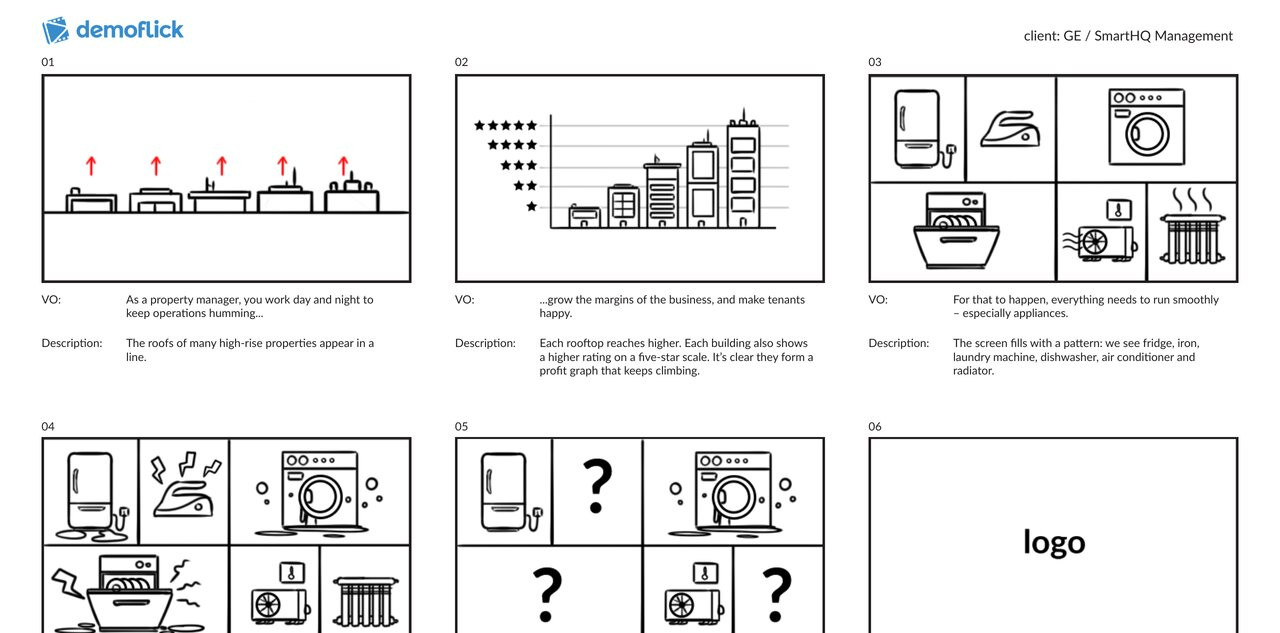
GE SmartHQ Management
A sketch-stage storyboard for GE Appliances' SmartHQ Management platform. Twenty frames, with the voiceover and scene description under each one.
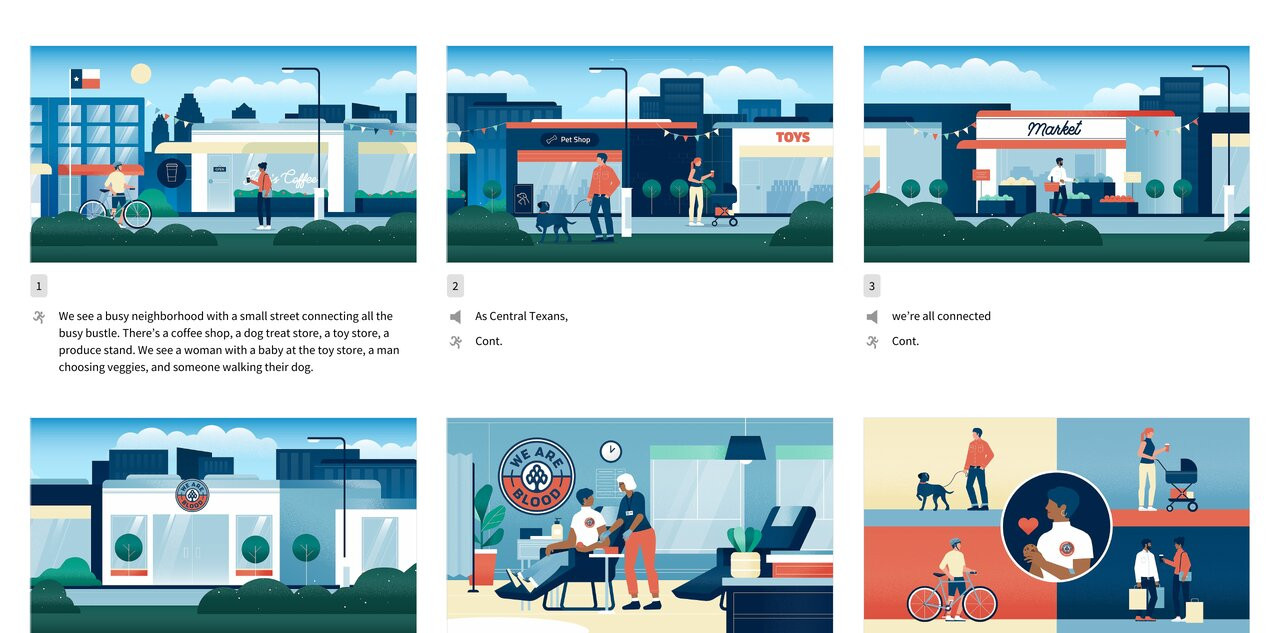
We Are Blood, Community Connection
A fully illustrated storyboard for a 30-second We Are Blood explainer. Seventeen frames, with the voiceover and motion direction under each one.
Get your storyboard approved before animation starts
Create scripts, storyboards, and animatics with your team.
Collect client feedback, keep every version on record, and go into production knowing exactly what was approved.